27 December, 2013

A Stoic Foreign Policy

Syria: What is in our control and what lies outside our control?
Discussing the tug of war between idealist foreign policy choices and realism the folks over at War on the Rocks hint on a policy truth that is just as true in our private lives, "the true path to immorality and catastrophe was found in mistaking the ought for the is." 

Anytime the world as we conceive it inside our head deviates from how it is in the flesh-space dimensions outside of our imagination, we are set up for disappointment at the least and tragedy at worse.  Some deviation is impossible to avoid, we do not have perfect knowledge.  Even the hardest nosed realist makes mistakes.  Yet when our view of the world is tinged by ideals, any set of ideas, we will develop a false view of the universe and, consequently, respond poorly.  The more ideals color our perception of the universe, the greater the error we are prone to inflict upon either ourselves or others.

The humility of stoicism is that the 
practitioner trains their mind to accept that which is outside of their control and to distinguish between our preferences and what is.  Perhaps we would prefer the world to be different but in in the very naming it as a preference we remove from the idea the power to delude us.  "Ought" is reserved for things within my control: my thoughts, my actions, my attitudes and even then what is ought is brought in line with the nature of the universe.  I ought to be an exemplar of what it means to be human and human.  I ought to execute my role well, whatever that role is.  I ought to be a model homo sapiens.     

It always escapes the confines of the lab.
The life excellently lived is a microscopic example of realist political action.  The thinking errors which lead an individual into a workplace tryst, thinking it good and will make them happy, are of the same kind that lead a nation's leaders to undertake an ill-advised war: consequences are obscured by misinformed emotion.  The stoic understands the good life to be one lived with courage, justice, prudence and temperance regardless of the circumstances or limits imposed by the world-as-it-is.  A realist foreign policy should be driven by the exact same motivations.  People are people.  Decisions are decisions.  Good thinking leads to good decisions regardless of the subject.  Bad thinking leads to bad decisions whether the damage is personal or commit the populace of an empire to ruin. 


Realists are the true ethicists and the most effective practitioners of compassion.  Ideology is always a simplified view of the world that forces an interpretation on every event in order to fit the worldview espoused. Regardless of the title, ideologues have decided, before the details of a problem are known, the proper course of action on the basis of the theory they hold to be true. 

Marcus Aurelius wrote, "The art of living is more like wrestling than dancing in so far as it stands ready against the accidental and the unforeseen, and is not apt to fall."  Ideology makes predictions as if life were a dance: predictable and rhythmic.  Children often think their lives will unfold in a predictable and benign manner.  Success require putting away childish things and "getting real" both in how we approach our personal lives and the public policy we advocate.


25 December, 2013

Book Review: The Epictetus Club

My wife has made amazing progress as a cook over our 18 years of marriage. Despite some wonderful meals in her repertoire, she still frequently falls into what I call the fast trap. When turning on the stove top on she reflexively spins the knob to high, and then attempt to ride the wave as she browns burger or sautés vegetables. Scorching is frequently the result and meals burned around the edges a regular occurrence. Dishes also become more onerous for what is essentially nothing more than a habit ingrained overtime.


The fast trap also springs when she does not think of the day’s meals as a daylong endeavor but approaches each meal reflexively in response to hunger. There are days when breakfast begins when a child clamors for it. Lunch preparation begins when she starts to get hungry at mid-day. Dinner is planned when I have begun to hunt through the cabinets, looking for sustenance. When meals are prepared for their speed and not necessarily their optimal taste or texture the family is fed but stress is acute and satisfaction is decreased.

There is a temptation to the fast trap whenever we discover a concept or idea that stuns us with its sense of promise. We want answers quickly. We want serenity now. We want five steps and two weeks to a better tomorrow. Some changes can be made quickly but long lasting change happen more slowly. We can grasp some ideas in a moment but others must sit and roast slowly in the crock pot of an unhurried mind if their full flavor is to emerge. Hope for serenity is smelled before it is tasted and the change in diet takes time to show itself in our overall health.
A few years ago I observed that my monotheism was dying. My moments of unbelief were growing longer and more certain and periods of faith shorter and presented as emotional responses rather than conviction. Disoriented I began to search for something solid about which to orient myself. In some passage of some book somewhere I came across a reference to Epictetus, a stoic philosopher of the second century of the Common Era. As I read his work I began to find hope for an anchored and disciplined life after the death of my god.

By the happenstance of history we have a remarkable corpus of Epictetus’ teachings available to us and I consumed them quickly. Some of it I understood immediately it was easily incorporated into my life. Other bits rattled around in my brain and with sometime I was able to sort them out. The meaning, let alone relevance, of other passages still eluded me. I read college textbooks about the teachings of Epictetus. I began to follow some blogs about contemporary stoic practice. I worked through other ancient and modern authors. I re-read the teachings of Epictetus in another translation thinking perhaps this would help make things clearer. I adopted some stoic practices myself but on the whole I was caught in my own kind of “fast trap.” I thought by turning the heat up higher, reading more words about stoicism, reading more sophisticated analysis of the ancient philosophical schools, that I could make my brain “cook faster” and see the results of a stoic education, if not immediately than quickly, but I was starting to feel a little crisp along the edges.

Reading The Epictetus Club by Jeff Traylor offers a taste of stoicism slowly cooked by an inmate with few books and an excess of time. Concepts that seem largely theoretical are made concrete through clear examples of life leading to and then within a state prison. The genesis of these stories and the desire to escape them are universal to being human: spousal conflict, desire to be a good parent, money problems, seeking a purposeful life, the temptation of shady business practices, worry of what the future holds, the instinct to avoid consequences for our own rule breaking, anger, yearning for respect, and the fear of death. They apply to us all as the author details as he applies the same questions the prisoners face to his own life as a newly minted college graduate beginning a career. The story is told in such a way that applying them to any setting or stage of life is a straightforward task.

Interspersed within compelling narrative the book is organized around ten central lessons taught by inmate “Zeno” that confront basic thinking errors human beings make and offers alternatives to replace them. Complete with exercises and illustrations, the book breaks down Epictetus’ teaching into easily understood bite-sized pieces. It leaves the reader with a slow cook recipie for "what I can work on next" which serves as an outlet other than my fast cooking habit of quickly moving on to another book.  If the book itself is not practical enough, it contains resources for an Epictetus Club program that can be used as a template for stoic practice.  It is not a source of go-to information about the philosopher or the first century but it is an accessible and practical outline of stoic practice. 

22 November, 2013

Power to the People

Because empowering people outside the bounds of central government control is dangerous.


He speaks of liberty, freedom and helping society’s marginalised. His dedication to civil liberties has brought him a loyal band of followers. Now Cody Wilson, scourge of the campaign to control the proliferation of arms, is coming to London with a new mission: to challenge the global financial system.  Mr Wilson, 25 – named by Wired magazine as one of the world’s 15 most dangerous people after he created a gun that can be downloaded and built with a 3D printer – is promoting a crypto-currency that would operate outside of government control.

The Independent

Tomorrow is the Big 4-0

Looking forward to the next forty, should I get them, I have just one wish: a face like Willie's.


21 November, 2013

"But I just want to be happy!"

I shudder a little inside when I hear anyone over the age of 12 using the word "happy."  In most cases I am pretty sure they do not know what they mean when they use the word.  A better Socratic would ask them about it.  Maybe I'll get there someday.  I am as confident as I am about anything, however, that many use the word happy to describe a "steady state" to be achieved and held and when they do so they are speaking of a fantasy: there are no steady states.  One would be just as well off as to own a trained unicorn or to retain title on a rainbow than achieve happiness as the concept is commonly employed.  In recent years I've taken up the use of the word "joy" and its cognates as a form of passive resistance to this trend.

There are those, however, attempting to redeem the term and return it to useful employment and there is an audience for what they are selling.  Stoicism is a practice of living that can be undertaken within nearly any other philosophical, cultural, or religious paradigm.  It seeks to supplant rival conceptions of what it means to live happily (or joyfully).  It rejects the hedonisms of any age, whether it be the hedonism of youth which seeks happiness in experiences, the hedonism of middle age in the collection of stuff, or the hedonism of the old which is reverence.     Likewise it rejects the conception of happiness which says, "Just go along to get along" a passive avoidance of actually living life in the hope of avoiding hassles, and settling for that small accomplishment as a happiness.

What is stoicism then?  In short it is a discipline of mind that only seeks what is within one's own control.  It is a lifelong discipline as our lives are in constant flux and not only is our environment changing but so too is our brain.  This is no small task but neither is it overwhelmingly difficult.  It will neither come with reading merely one book or a "graphic novel" but neither is there is a need to lock one's self up in a monastic's cell for a decade of chanting and meditation.  Stoicism overlaps greatly with a modern approach to psychotherapy: Cognitive Behavioral Therapy (CBT).  Likewise it can be thought of as a kind of Western Buddhism, while Christianity might be said to have drank stoicism's milkshake, stoicism never really went away.   If you already accept that the elusive nature of happiness might have even a small part to do with what bounces around in your own head rather than being the full and total responsibility of your circumstances, stoicism/CBT might be helpful in gaining ground on your own pursuit of happiness.

As for what a daily practice of stoicism is or might look like, I'll describe my personal practices in a later post but the disciplines of mind I seek are standard.  For a beginners approach to stoic practice, no one is doing more work helping women and men get started then Don Robertson and I'd defer to his suggested starting point with only a single recommendation: the use of writing a few short sentences every morning and evening to make the practice a little more concrete and a little less mental.  More of us remember to brush our teeth just before bed than remember to be grateful for the day for the very reason that one is concrete and the other is not.  If you want a more intense introduction, by all means check out the Live like a Stoic Week 2013 Handbook.

19 November, 2013

270 Words

On this, the 150th Anniversary of the Gettysburg address we remember those husbands and sons who did not die in vain.  My grandfather tells me about his grandfather, who fought and returned home intact, at least physically intact, from that war.  We easily forget with our Facebook updates and Obamacare failures but these words remind us of the carnage that took place during those years and the relative magnanimity that followed the south's defeat, magnanimity born of the knowledge that we were all still, or rather again, one nation.  When we have difficulty giving grace to our political opponents who do no more than insult our own narrow conception of good sense, we demonstrate our own ignorance, shortsightedness, and vainglorious pride.

You don't have to say much to mean much.  It doesn't take much to forgive much.  Everything hinges on remembering, despite our differences, we are all Americans and "jaw, jaw is better than war, war."

 
Four score and seven years ago our fathers brought forth on this continent a new nation, conceived in liberty, and dedicated to the proposition that all men are created equal.
Now we are engaged in a great civil war, testing whether that nation, or any nation so conceived and so dedicated, can long endure. We are met on a great battlefield of that war. We have come to dedicate a portion of that field, as a final resting place for those who here gave their lives that that nation might live. It is altogether fitting and proper that we should do this.
But, in a larger sense, we can not dedicate, we can not consecrate, we can not hallow this ground. The brave men, living and dead, who struggled here, have consecrated it, far above our poor power to add or detract. The world will little note, nor long remember what we say here, but it can never forget what they did here. It is for us the living, rather, to be dedicated here to the unfinished work which they who fought here have thus far so nobly advanced. It is rather for us to be here dedicated to the great task remaining before us—that from these honored dead we take increased devotion to that cause for which they gave the last full measure of devotion—that we here highly resolve that these dead shall not have died in vain—that this nation, under God, shall have a new birth of freedom—and that government of the people, by the people, for the people, shall not perish from the earth.

15 November, 2013

Milleniels


They'll be alright.  Nothing a little time under pressure can't fix.

14 November, 2013

Thursday is for Politics

The big policy disagreement in this household the last year has been how to read the "Common Core" standards.  This is the first critique that strikes me as having real substance.

Core Meltdown Coming

I’ve stayed mostly out of the Common Core nonsense. The objections are mostly fuss about federal control, teacher training, curriculum mandates, and the constructivist nature of the standards. Yes, mostly. But so what? Here’s the only important thing you need to know about Common Core standards: they’re ridiculously, impossibly difficult.
I will focus here on math, but I’m an English teacher too, and could write an equivalent screed for that topic.
I’m going to make assertions that, I believe, would be supported by any high school math teacher who works with students outside the top 30%, give or take.
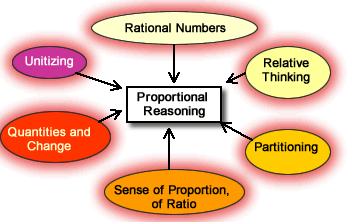
Two to three years is required just to properly understand and apply proportional thinking–ratios and percentages. That’s leaving off the good chunk of the population that probably can’t ever truly understand it in non-concrete situations. Proportional thinking is a monster. That’s after two to three years spent genuinely understanding fraction operations. Then, maybe, they could get around to understanding the first semester of first year algebra–linear equations (slopes, more proportional thinking), isolating variables, systems, exponent laws, radicals—in a year or so.
In other words, we could use K-5 to give kids a good understanding in two things: fractions and integer operations. Put measurement and other nonsense into science (or skip it entirely, but then remember the one subject I don’t teach). Middle school should be devoted to proportional thinking, which will introduce them to variables and simple isolation procedures. Then expand what is currently first semester algebra over a year.

A co-worker was fired for a broach of public morality that our employer thought disregarded our "corporate values," which is to say the values of the institutions aristocracy.  In a free nation, with a freedom of association, I respect the rights of my employer to fire my friend, even as I am more in agreement with my friend than the aristocrats who fired him.  That right of free association, however, extends to all institutions and liberty does not mean that certain groups are afforded special protection as a political favor to tie up their votes.

ENDA is a bad idea

When Washington first passed employment discrimination laws, Congress saw that anti-black discrimination was so widespread, so destructive and so intractable that the government was compelled to impose a remedy on private business. The question today is whether another intervention is warranted — or will it do more harm than good.
The Employment Non-Discrimination Act (ENDA) passed the Senate on Nov. 7 with supporters promising to end anti-gay discrimination in the workplace. The law may or may not do that — but it will certainly ban legitimate practices by private employers. Federal laws, after all, are not precision-guided weapons. They are blunt and they always inflict collateral damage.
If the Washington Examiner refused to hire a reporter simply because the reporter was gay, that would be wrong. But one can imagine cases in which an employer might justly place on employees conditions that are tied up with sexuality or gender identity.

The problem with the article is the psychological need to bring global warming into the story and emphasize as fact what is not yet understood: the many ways beyond luminosity that the sun impacts earth's climate.

Strange Doings on the Sun

Something is up with the sun.
Scientists say that solar activity is stranger than in a century or more, with the sun producing barely half the number of sunspots as expected and its magnetic poles oddly out of sync.
The sun generates immense magnetic fields as it spins. Sunspots—often broader in diameter than Earth—mark areas of intense magnetic force that brew disruptive solar storms. These storms may abruptly lash their charged particles across millions of miles of space toward Earth, where they can short-circuit satellites, smother cellular signals or damage electrical systems.
Based on historical records, astronomers say the sun this fall ought to be nearing the explosive climax of its approximate 11-year cycle of activity—the so-called solar maximum. But this peak is "a total punk," said Jonathan Cirtain, who works at the National Aeronautics and Space Administration as project scientist for the Japanese satellite Hinode, which maps solar magnetic fields.

12 November, 2013

Stupid Smokestack

A Free People

will not be controlled.  It is best engage in the positive work of building a society where legislation is limited to those areas where there is broad consensus.  If you can build a 1911 with a 3D printer, you're not far away from printing a fully automatic AR-15.  Either we can live in a tolerant nation where the harmless minority is allowed to live as it wills or we can construct a police state to enforce meddlesome legislation which no one really cares about.  A diverse society which is also an armed society is a libertarian society.


11 November, 2013

Armistice Day 2013

We remember and honor the sacrifice of war's veterans, regardless of what we now think of the war the in which they served.  We acknowledge those who did not return whether they volunteered or were drafted, whether they believed in what they were doing or were just looking to come back home.  We acknowledge that war is, in the course of human events, necessary if a people are to remain free but that the cost is always greater than the politicos promise "to be home by Christmas."  We remember, but we do not celebrate.  War is always a tragedy, especially to those who are most intimately impacted by it.

We reserve the right, however, to curse throughout eternity those leaders who through ignorance, neglect, deception, or any combination of the three lead live to a ripe old age after leading us into senseless wars which serves only their own egos, delusions, or narcissism.


08 November, 2013

A Year's Potatoes

Downs the road a ways is a potato warehouse and sorting facility.  If you pick them up there, they are $0.20 a pound.  We make use of a root cellar to buy in season and in bulk.  I got three growing kids and the dimes add up.
Our house did not have a root cellar when we bought it but it had the perfect spot for one and an afternoon and fifty dollars was all I needed to build one.  I know an old man in town who sells food grade barrels, most of them originally held Tabasco sauce, saw off the top and some scrap plywood for a lid, and you are set.  The spuds last more than a year in storage and we have one less thing to pick up at the grocery store.
400# in the cellar.


The last of last year's potatoes, still firm and tasty.


They come in the house about 20# at a time.

06 November, 2013

Statistics

Half a million miles over ten years in my own vehicle without a cracked windshield.  Thirty miles over forty minutes in a borrowed pickup and the universe gives me this gift.